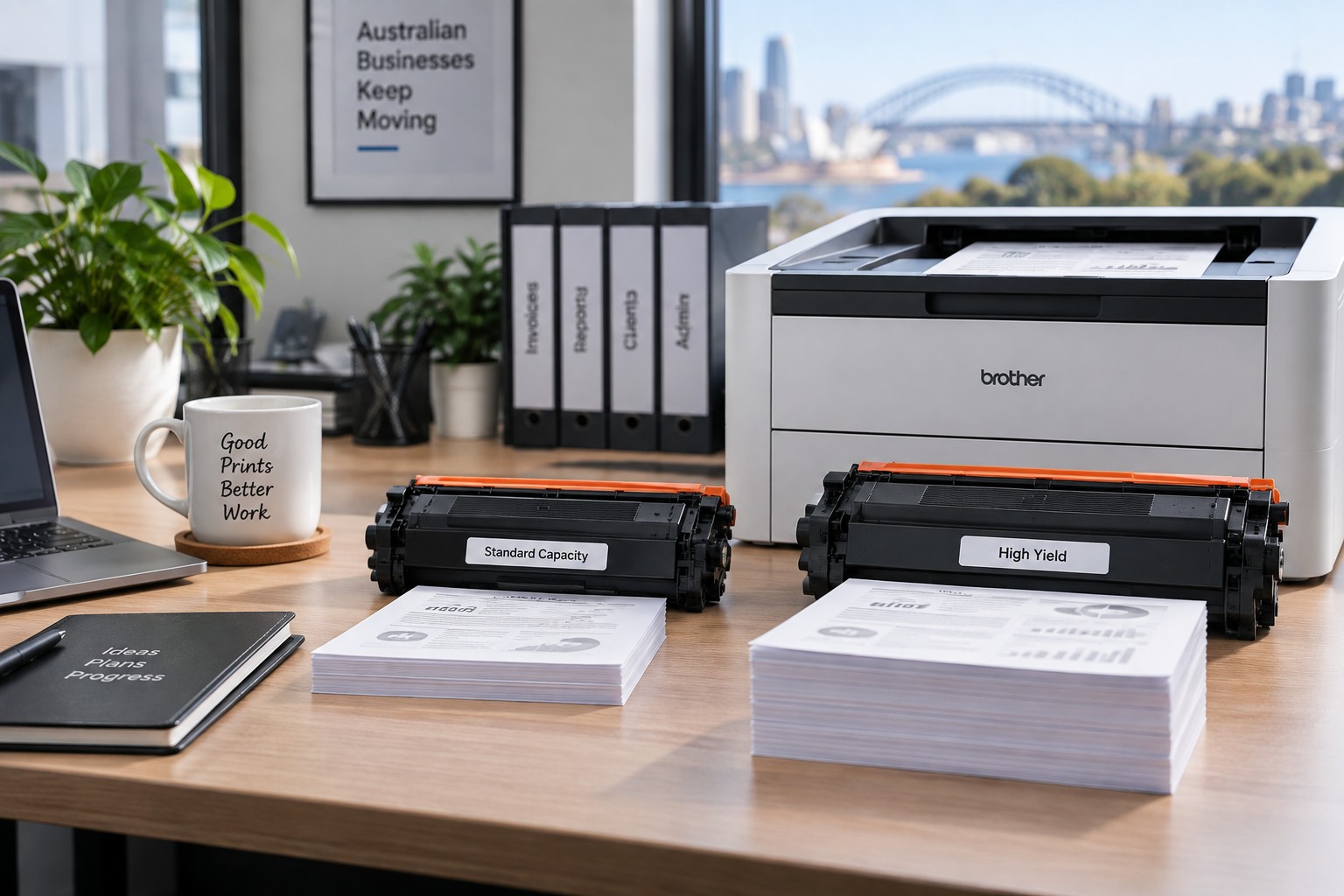
If you’ve ever bought toner for a printer, you’ve probably noticed that the same printer can have both a standard toner and a high-yield toner option.
The high-yield cartridge usually costs more, so it’s tempting to grab the cheaper one and move on.
But that doesn't always work out cheaper.
The real difference comes down to how many pages the cartridge can produce, how much you print and what each page costs you.
For someone printing the occasional document at home, standard toner may do the job perfectly well. For a busy office printing invoices, reports, forms or client documents every day, a high-yield cartridge can mean fewer replacements and a lower cost per page.
So, what is the difference between standard and high-yield toner, and which one makes sense for your printer?
Let's break it down.
What Is Standard Toner?
A standard toner cartridge is the regular-capacity option available for a particular printer.
It contains less toner than a high-yield version and generally has a lower rated page yield. The upfront price is usually lower as well.
For households and smaller workplaces with fairly light printing needs, standard toner can be a sensible option.
Say you have a home office and mainly print letters, invoices, forms and the occasional document. If a standard cartridge lasts you several months, paying extra for a larger cartridge may not give you much practical benefit.
The cartridge price alone, however, doesn't tell the whole story.
Imagine a standard cartridge costs $60 and has a rated yield of 1,500 pages:
$60 ÷ 1,500 = 4 cents per rated page
That gives you a simple figure to use when comparing it with another cartridge.
Actual printing costs can vary because your documents won't necessarily use toner at the same rate as the pages used for yield testing.
What Is High-Yield Toner?
A high-yield toner cartridge contains more toner and is designed to produce more pages than the standard version for the relevant printer.
You'll see different naming conventions depending on the manufacturer. Terms such as high capacity, XL, HY or X may be used, but the exact cartridge number is more reliable than the label.
The biggest advantage is capacity.
Instead of replacing a cartridge as often, you can print more pages before the next replacement is needed. That's particularly useful in workplaces where the printer gets a workout every day.
For example, suppose a high-yield cartridge costs $90 and has a rated yield of 3,000 pages:
$90 ÷ 3,000 = 3 cents per rated page
You’re paying more upfront, but the rated cost per page is lower than the standard example above.
There can also be a practical benefit. If you're regularly printing hundreds of pages, fewer cartridge changes means less interruption and fewer consumables to keep in the cupboard.
Standard vs High-Yield Toner: What's the Difference?
The simplest way to look at it is lower upfront cost versus greater capacity.
| Standard toner | High-yield toner | |
| Upfront price | Usually lower | Usually higher |
| Toner capacity | Lower | Higher |
| Rated page yield | Lower | Higher |
| Replacement frequency | Usually higher | Usually lower |
| Suitable for | Light to moderate printing | Moderate to heavy printing |
| Cost per page | May be higher | May be lower |
Neither option automatically wins.
If you print very little, the lower purchase price of a standard cartridge may suit you better.
If your printer is producing documents all week, the extra capacity of a high-yield cartridge can be more useful.
The sensible comparison is cartridge price + page yield + your actual printing habits.
What Does Toner Page Yield Mean?
Toner page yield refers to the number of pages a cartridge is expected to produce under a defined testing method.
It's one of the most useful figures when comparing cartridges, but it isn't a promise that your cartridge will print exactly that number of pages.
Think about the difference between printing a two-page letter and printing pages packed with graphics, tables and dark images. They won't use the same amount of toner.
Your printer settings, document content and printing conditions can all affect the result.
Current international standards include ISO/IEC 19752:2025 for monochrome toner cartridges and ISO/IEC 19798:2025 for colour toner cartridges. These standards provide defined methods for measuring cartridge yield and make comparisons between products more meaningful. (ISO)
Your everyday results can still differ from the published figure.
That's why page yield is best used as a comparison tool, rather than a guaranteed number of pages.
How Much Does Toner Cost Per Page?
A quick calculation can tell you quite a bit.
Cartridge price ÷ rated page yield = approximate cost per rated page
For example:
| Cartridge | Price | Rated yield | Approx. cost per rated page |
| Standard | $55 | 1,500 pages | 3.67c |
| High-yield | $90 | 3,000 pages | 3c |
The high-yield cartridge costs $35 more to purchase.
However, based on the rated yield, each page costs less.
This is why choosing toner purely because it has the lower shelf price can be misleading.
Of course, toner is only one part of your overall printing costs. Paper, maintenance, printer servicing and replacement parts can also add up.
For cartridge comparisons, though, cost per page gives you a much clearer picture than the purchase price alone.
How Does Printing Volume Affect Your Choice?
Your printing volume matters more than whether one cartridge looks cheaper at first glance.
Occasional printing
If you're printing a few documents here and there at home, standard toner may be all you need.
There's little point paying considerably more for capacity that you won't use for a long time.
Regular printing
If you're printing throughout the week, it’s worth looking at both cartridge options and working out the approximate cost per page.
The extra capacity of high-yield toner may start to make more sense, particularly if you're frequently replacing standard cartridges.
Heavy printing
Busy offices, schools, healthcare providers, accountants, law firms and other print-heavy workplaces can go through toner quickly.
In these environments, fewer cartridge changes can make day-to-day printing a little easier.
There's no magic page count where everyone should switch to high-yield. Cartridge prices and page yields vary between printer models, so your own usage is a better guide.
A simple way to start is to look at how many cartridges you've gone through over the past few months.
How Do You Find the Right Toner for Your Printer?
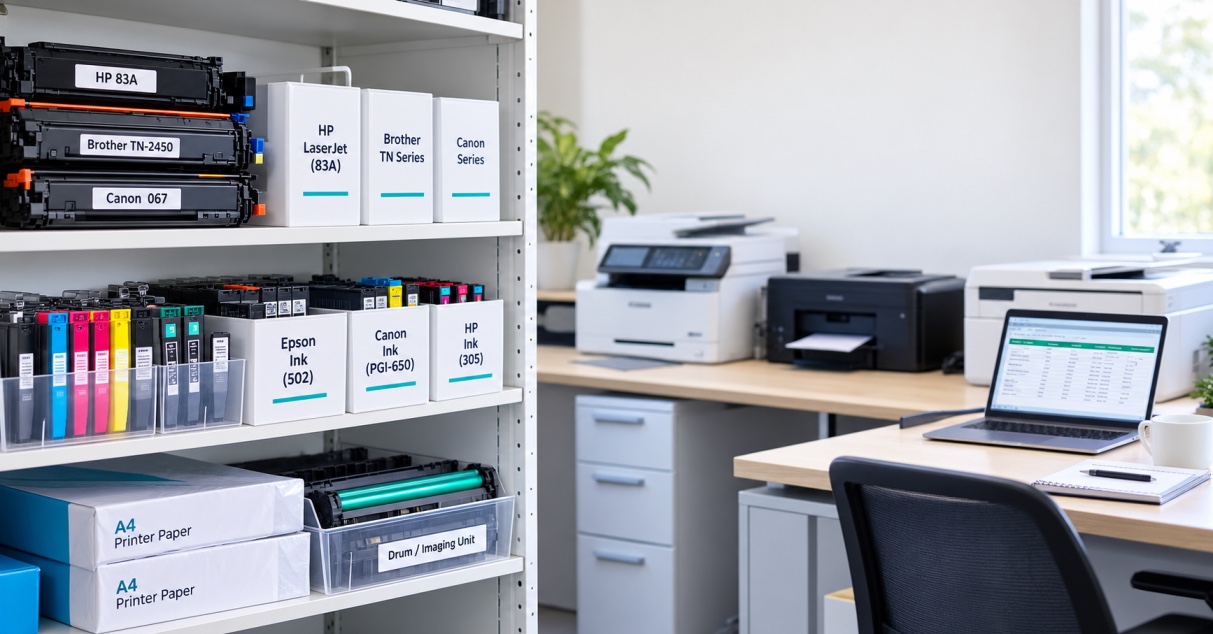
Once you've decided between standard and high-yield, you still need the cartridge that actually belongs in your printer.
Start with the exact printer model.
You can usually find the model number on the front or top of the machine. It may also appear in your computer's printer settings or on the original packaging.
Next, look at the cartridge number.
For example, if you're replacing an existing cartridge, the product number printed on it can be a useful starting point when searching for a replacement.
Then consider:
- The exact printer model
- Cartridge number
- Black or colour
- Standard or high-yield capacity
- Rated page yield
- Genuine or compatible cartridge
The Toner Group's Ink & Toner Finder can help Australian customers search for cartridges using their printer or cartridge details.
It's much safer to match the specific model and cartridge number than to search broadly for something like "HP black toner" or "Brother toner".
Genuine or Compatible Toner: Does It Matter?
You may also come across genuine OEM and compatible toner when shopping for a replacement.
Genuine cartridges are produced by the printer manufacturer.
Compatible cartridges are made by another manufacturer for use with particular printers.
Both can be available in standard and high-yield capacities, depending on the printer and cartridge family.
If you're considering a compatible cartridge, pay attention to the printer models and cartridge numbers listed for it. Compatibility is specific to the cartridge and printer combination.
For a home user, the priorities may be different from those of an office printing hundreds of pages every week. Consider the type of printing you do, how frequently the printer is used and the level of support you want from your supplier.
Is High-Yield Toner Actually Worth It?
Sometimes yes. Sometimes standard toner makes more sense.
It comes down to the numbers.
Suppose you print 2,000 pages a month and your standard cartridge is rated for 1,000 pages. You could be replacing cartridges fairly regularly.
If the high-yield alternative produces 3,000 pages and gives you a lower cost per rated page, it may be a more practical option.
Now imagine you print only 100 pages a month.
That larger cartridge might last a very long time. In that situation, the higher upfront price may not offer much advantage.
So rather than asking whether high-yield toner is simply "better", ask:
How much do I print, and what will each page cost?
That's a far more useful way to decide.
Before Buying Your Next Toner Cartridge
A few details are worth looking at before placing an order:
- Printer model: Match the exact model number.
- Cartridge number: Compare it with the cartridge already in your printer.
- Page yield: Look at the manufacturer's rated yield.
- Printing volume: Consider how many pages you normally produce each month.
- Cost per page: Divide cartridge price by rated yield.
- Capacity: Decide whether standard or high-yield suits your workload.
- Cartridge type: Consider genuine and compatible options available for your printer.
- Colour: Choose the correct black or colour cartridge.
- Supplier support: Look for clear product information and assistance if you're unsure about compatibility.
Spending a couple of minutes on these details can save you from ordering the wrong cartridge or paying more than necessary.
Standard or High-Yield Toner: Which One Makes Sense?
There isn't one answer for every printer user.
Standard toner can be a good fit for lighter printing where keeping the initial purchase price down matters.
High-yield toner can be useful for regular or heavier printing, particularly when the additional capacity brings down the cost per page and reduces how often you need a replacement.
For Australian homes and businesses, the decision really comes down to printing volume, page yield and cost per page.
Don't automatically choose the cheapest cartridge on the shelf, and don't assume the biggest cartridge is always the best value either.
Look at how much you actually print and choose the capacity that fits your workload.
If you know your printer model or existing cartridge number, you can browse The Toner Group's toner range or use the Ink & Toner Finder to find options available for your machine.
Frequently Asked Questions
Is high-yield toner better than standard toner?
Not necessarily. High-yield toner produces more pages, but its value depends on your printing volume, cartridge price and cost per page.
Is high-yield toner cheaper per page?
It can be. Divide the cartridge price by its rated page yield to get an approximate cost per rated page, then compare it with the standard option for the same printer.
Does high-yield toner last longer?
It is designed to produce more pages than the standard cartridge for the relevant printer. How long it lasts depends on how much and what you print.
Does high-yield toner fit the same printer as standard toner?
Some printer models support both standard and high-yield cartridges, while others may not. Always match the cartridge number with your specific printer.
Why does my toner run out before the advertised page yield?
Published yields come from defined testing conditions. Your documents may use more toner than the test pages, particularly when printing graphics, images or pages with heavy coverage.
Final Takeaway
When choosing between standard vs high-yield toner, the price on the cartridge is only one part of the equation.
Look at the rated page yield, cost per page and the amount you print.
For occasional printing, standard toner may be perfectly adequate. For a busy office printer, high-yield toner may reduce replacement frequency and provide a lower cost per rated page.
Most importantly, match the cartridge to your exact printer model and cartridge number.
That way, you're not simply buying more toner. You're choosing a cartridge that makes sense for the way you actually print.