
Choosing between a laser printer and an inkjet printer can affect much more than the price you pay on day one. The wrong choice can mean higher running costs, slower printing or disappointing print quality for years.
So, which is better: laser printer vs inkjet printer?
For text-heavy, high-volume printing, a laser printer is usually the better choice because it is fast, efficient and designed around toner. For photos, colour graphics and lower-volume home printing, an inkjet can make more sense.
This guide breaks down the real differences between laser vs inkjet printers, including running costs, speed, print quality, maintenance and the best option for different types of users.
If you're already comparing supplies for your printer, you can also browse our printer supplies and toner options to see what is available for your model.
How Laser and Inkjet Printers Actually Work
The biggest difference between the two technologies is how they put an image onto the page.
A laser printer uses toner, a fine powder that is transferred to the paper and fused using heat. This process is particularly well suited to producing large quantities of sharp text and business documents quickly.
An inkjet printer uses liquid ink, spraying tiny droplets through print nozzles onto the paper. Because ink can be precisely placed in different colours, inkjet printers are particularly useful for photographs, illustrations and detailed colour graphics.
That basic difference helps explain many of the differences you'll see when comparing them:
- Running cost: toner cartridges generally provide high page yields, while ink cartridge costs depend heavily on cartridge capacity and usage.
- Speed: laser printers are generally faster for text-heavy documents.
- Text quality: laser printers typically produce crisp, consistent text.
- Photo and colour printing: inkjets are often better suited to photographs and detailed colour images.
- Maintenance: each technology has different maintenance requirements, depending on the printer and how it is used.
The best printer isn't necessarily the one with the lowest purchase price. It's the one that matches how you actually print.
Cost Per Page: Laser vs Inkjet
Printer price is only one part of the total cost of ownership.
An inexpensive printer can become expensive if its cartridges need frequent replacement. Conversely, spending more on a printer initially can make sense if its consumables provide better value for the volume you print.
In general, laser printers tend to offer a lower cost per page for high-volume document printing, while inkjets can be attractive for users who print less frequently or need strong colour and photo output.
However, there is no universal cost-per-page figure for every printer. Page yield, cartridge capacity, coverage, colour usage and whether you choose standard or high-yield cartridges can all affect the result.
Quick cost comparison — laser vs inkjet
| Factor | Laser Printer | Inkjet Printer |
| Upfront printer cost | Often higher | Often lower |
| Consumable | Toner | Ink |
| Replacement frequency | Generally lower for high-volume use | Depends heavily on usage and cartridge capacity |
| Text-heavy printing | Usually economical | Can become costly at higher volumes |
| Photo printing | Good on suitable models, but not usually the main strength | Generally better suited |
| High-volume office use | Strong choice | Depends on printer and workload |
| Low-volume home use | Can be suitable | Often a practical choice |
One important point is cartridge yield. A standard cartridge and a high-yield cartridge for the same printer can have very different economics.
For example, someone printing hundreds or thousands of pages every month should look beyond the printer's purchase price and compare the expected toner or ink consumption.
For compatible supplies, check the exact printer model before ordering. You can compare available HP toner cartridges and Canon/HP ink cartridges based on the printer you already own.
Speed, Print Quality and Best Use Cases
The right choice also depends on what you're printing.
Laser printers: best for documents and volume
Laser printers are generally a strong fit for businesses and organisations that print a lot of documents.
They are particularly useful when the workload consists mainly of:
- Invoices and financial documents
- Contracts and legal documents
- Reports
- Forms
- Internal business documents
- School worksheets and administration
- Black-and-white office documents
- Large batches of text-heavy pages
For an accountant or law firm, for example, sharp text and consistent output may be more important than photographic colour reproduction. A laser printer can be a practical fit for that type of environment.
They can also make sense for healthcare providers, corporate offices and other workplaces where printing is frequent and reliability and predictable consumable usage matter.
Inkjet printers: best for photos and colour
Inkjet printers are often the better option when colour and image quality are priorities.
They can be particularly useful for:
- Family photographs
- Colour presentations
- Marketing materials
- School projects
- Illustrations
- Graphics
- Occasional home printing
For a homeowner who prints a few documents and photographs rather than hundreds of pages each week, an inkjet may provide the flexibility they need without requiring a laser printer designed around higher-volume workloads.
What about a home office?
A home office printer sits somewhere between personal and business use.
If you mainly print emails, invoices, reports and documents, a laser printer can be worth considering, especially if your monthly page count is relatively high.
If your home office also involves photographs, colour graphics or occasional creative projects, an inkjet may offer more versatility.
The key question isn't simply "Which printer is better?" Ask:
What do I print, how often do I print it, and how much am I willing to spend on consumables?
What about print-intensive businesses?
For print-intensive workplaces, the calculation changes significantly.
A business printing large volumes should consider:
- Expected monthly page volume
- Black-and-white versus colour requirements
- Toner or ink page yield
- Standard versus high-yield cartridges
- Printer speed
- Maintenance requirements
- Network and workflow requirements
- Availability and cost of replacement supplies
For organisations with substantial printing needs, printer maintenance and managed print services can also become more important than the initial printer purchase.
Check Cartridge Compatibility Before Buying
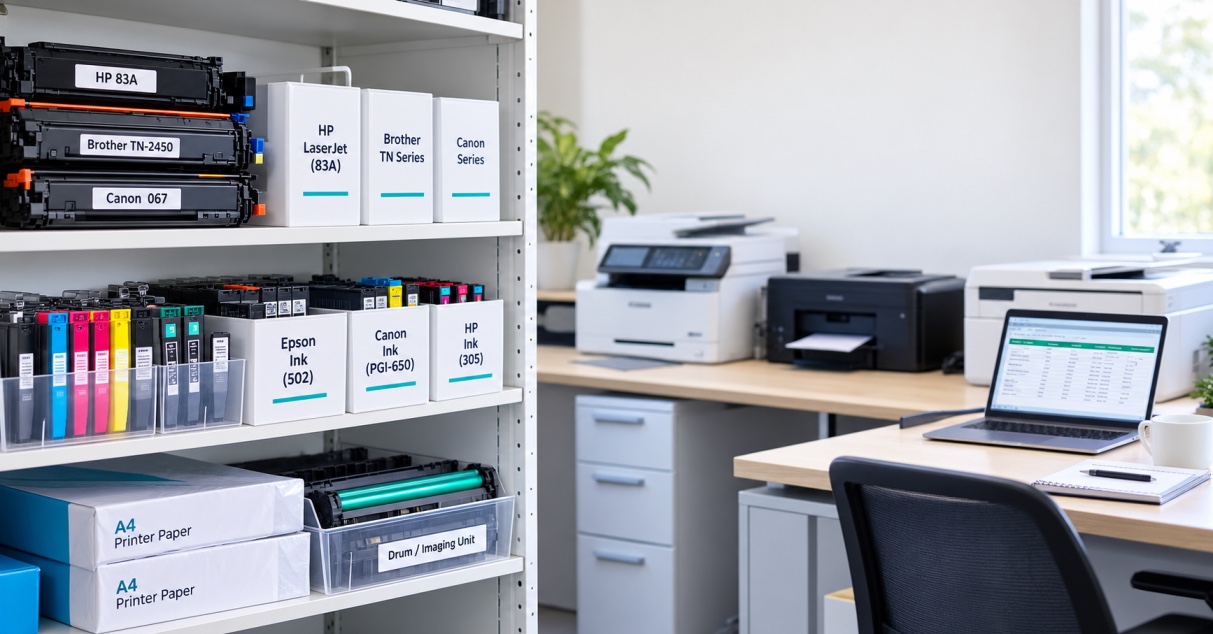
Whether you choose laser or inkjet, don't order a cartridge based only on the brand name.
Always check the exact printer model and compatible cartridge number before purchasing.
For example, knowing that you have an HP printer isn't enough to identify the correct toner. Different HP printer models can require completely different toner cartridges.
The same applies to Canon and other brands.
Before ordering, check:
- Exact printer model
- Cartridge or toner number
- Whether the cartridge is black or colour
- Standard or high-yield capacity
- Original versus compatible cartridge
- Whether the supplier confirms compatibility
This simple check can prevent the common problem of receiving a cartridge that physically looks similar but isn't designed for your printer.
It's also worth considering your actual printing pattern. Someone who prints occasionally may prioritise cartridge convenience and colour quality, while a business printing thousands of pages may care much more about page yield and total running cost.
If you're unsure which cartridge you need, a printer buying and setup guide can help you work through the important specifications before ordering.
So, Which Is Better: Laser or Inkjet?
There isn't one winner for every user.
Choose a laser printer if you:
- Print mostly documents
- Print frequently or in large volumes
- Need fast text printing
- Want to prioritise toner efficiency for high-volume workloads
- Run an office, school or document-heavy business
Choose an inkjet printer if you:
- Print photographs or detailed colour graphics
- Print relatively low volumes
- Want a versatile home printer
- Need strong colour reproduction
- Use your printer for both documents and creative projects
The most important part of the printer comparison is matching the technology to your workload.
A homeowner who prints 20 pages a month has different requirements from a law firm printing hundreds of pages every day. Similarly, a graphic-focused user may value colour output more than a business that primarily prints contracts and invoices.
Find the Right Printer Supplies for Your Setup
Once you've decided between laser and inkjet, the next step is making sure you have the right consumables for your specific printer.
You can browse HP toner cartridges for compatible laser printer models or look at Canon and HP ink cartridges for inkjet printers.
If you're buying a printer for a workplace, upgrading an existing setup or managing a larger print volume, it's also worth considering the long-term cost of supplies and maintenance rather than focusing only on the initial printer price.
If you're unsure what fits your printer or need help with bulk supplies, printer maintenance or managed print requirements, getting advice before ordering can save both time and money.
FAQs
Is laser or inkjet cheaper in the long run?
For high-volume, text-heavy printing, a laser printer will often be more economical because toner cartridges can provide high page yields. However, actual running costs depend on the specific printer, cartridge yield, print coverage and usage.
Which is better for photo printing?
Inkjet printers are generally better suited to photo printing because they use liquid ink and are designed to produce detailed colour output on suitable photo media.
Do laser printers need less maintenance than inkjets?
Laser and inkjet printers have different maintenance requirements. Laser printers don't have liquid ink that can dry in the print system, while inkjet printers may require attention to printheads and nozzles depending on the model and usage pattern.
Can I use compatible toner or ink in either type?
Compatible consumables are available for many laser and inkjet printers, but compatibility depends on the exact printer model and cartridge specification. Always verify compatibility before purchasing.
Which is best for a home office versus a busy workplace?
A home office with occasional colour and photo printing may benefit from an inkjet. A busy workplace printing large quantities of documents will often be better suited to a laser printer.
Do inkjet printers dry out if not used often?
Inkjet printers can experience ink and printhead-related issues when they are left unused for extended periods. The likelihood and severity depend on the printer, ink system and storage conditions.
Final Verdict
The laser printer vs inkjet printer decision comes down to your printing habits.
For fast, high-volume document printing, a laser printer is usually the stronger choice. For photographs, colour graphics and flexible lower-volume home printing, an inkjet can be a better fit.
Before buying, look beyond the sticker price. Compare the printer's expected workload, cartridge yield, consumable costs, print quality, speed and maintenance requirements.
And whichever technology you choose, always confirm the exact cartridge or toner compatibility before placing an order.